





Safety Standards and Compliance for Prize Dispenser Machines

- Regulatory landscape and risk foundations
- Key international standards and regulators
- Risk assessment as a starting point
- How regulations vary by market
- Mechanical safety and physical design
- Guarding moving parts and access control
- Prize containment and choking hazard mitigation
- Durability and materials selection
- Electrical, EMC, and software safety
- Electrical protection and grounding
- Electromagnetic compatibility (EMC)
- Software safety and payment systems
- Testing, certification, and operational compliance
- Typical compliance pathway
- Common tests and what they demonstrate
- Maintenance, documentation, and traceability
- Case studies, real-world issues, and mitigation strategies
- Common field failures and their root causes
- Mitigation strategies that work in practice
- Data-backed reliability targets
- Industry best practices for children and family venues
- Labeling, warnings, and operator responsibility
- Hygiene and consumable prizes
- Childproofing and supervised play
- Jiami Games: how a manufacturer can align compliance with commercial needs
- Frequently Asked Questions (FAQ)
- 1. What standards should I prioritize for a prize dispenser machine intended for Europe?
- 2. Are prize machines required to be UL listed in the United States?
- 3. How do I manage choking hazards from small prizes?
- 4. What documentation do regulators expect when I sell internationally?
- 5. How often should I inspect and maintain prize dispenser machines in public venues?
- 6. What about software vulnerabilities in modern prize dispensers?
- Contact and next steps
As a consultant with years of experience in arcade game machines and prize-winning game consoles, I focus on actionable, verifiable safety practices that help operators, distributors, and manufacturers meet international compliance requirements. This article explains the regulatory landscape, risk-assessment methods, electrical and mechanical safety measures, child-specific protections, and practical testing and documentation steps for prize dispenser machines and related arcade devices. I include industry-standard references and clear guidance you can implement to reduce liability, improve uptime, and ensure your machines are market-ready.
Regulatory landscape and risk foundations
Key international standards and regulators
Prize dispenser machines are electro-mechanical devices that combine electrical systems, moving parts, user interaction, and often small prize items. Because of that, multiple standards may apply. Notable frameworks include CE marking requirements under the European Union (Low Voltage Directive, EMC), the International Electrotechnical Commission (IEC) standards such as IEC 62368-1 for audio/video/ICT equipment, and safety-of-machinery standards such as ISO 12100 for risk assessment and reduction. In the United States, oversight often involves the Consumer Product Safety Commission (CPSC) and product-safety standards from organizations like ASTM. For electrical safety and certification marking, organizations such as UL provide recognized test standards and listings.
Risk assessment as a starting point
Before selecting specific standards or tests, perform a documented risk assessment in line with ISO 12100. I always start by mapping hazards (electrical shock, pinch points, entrapment, choking on small prizes, fire risks, and user misuse) and then evaluate exposure, severity, and existing safeguards. This determines whether you need mechanical guarding, electrical isolation, child-safety labeling, or software interlocks. The risk assessment is also the foundation for technical files required for CE, UL, or similar conformity assessments.
How regulations vary by market
Regulatory emphasis differs: the EU focuses on essential safety requirements and self-declaration via CE (with harmonized standards supporting conformity), while the U.S. relies more on agency enforcement and accepted third-party certifications like UL listings. Exporters must harmonize their product design to meet the most stringent market they intend to serve and maintain documentation to demonstrate compliance globally.
Mechanical safety and physical design
Guarding moving parts and access control
Prize dispenser machines contain mechanisms such as conveyors, rotating arms, and claw assemblies. Safeguarding must prevent user contact with moving parts. Practical controls include fixed guards (transparent polycarbonate panels), interlocked access doors that cut power when opened, and rounded edges to reduce impact injuries. For any service panels, use tamper-resistant fasteners and clearly marked maintenance procedures.
Prize containment and choking hazard mitigation
Small prizes create choking hazards—particularly when machines are aimed at children. Design choices reduce risk: limit prize size for installations accessible to young children, include warning labels, and provide optional prize containers that reduce direct hand access to small items. Where edible prizes are dispensed, follow relevant food-contact and labeling regulations and maintain hygiene protocols.
Durability and materials selection
Materials should resist sharp fractures and flammability. For structural panels, PCB-backed glass or polycarbonate are preferred over brittle acrylics. Use flame-retardant cable insulation and comply with regional flammability standards. Regular wear testing and environmental exposure tests (humidity, UV, salt spray for coastal deployments) should be part of product validation.
Electrical, EMC, and software safety
Electrical protection and grounding
Electrical safety basics include proper insulation, circuit protection (overcurrent devices, fuses), and reliable grounding to prevent shock. Design for compliance with applicable electrical standards: IEC 62368-1 for many regions, or UL 62368-1 in North America. For wiring and connectors used in prize dispensers, ensure IP ratings where moisture ingress is a concern and label mains ratings clearly on the machine chassis.
Electromagnetic compatibility (EMC)
Electromagnetic interference from motors, solenoids, and power supplies can affect sensors and payment systems. EMC testing and mitigation (filtering, shielding, cable routing) are essential for reliable operation. In the EU, EMC compliance is part of CE requirements; in other markets, EMC testing per IEC standards is recognized by many certification bodies.
Software safety and payment systems
Modern prize dispenser machines often include embedded software for gameplay, prize logic, and payment processing. Software must fail-safe—e.g., a watchdog that returns the machine to a safe state on fault. Payment modules must comply with PCI-DSS and use secure, certified card readers where applicable. Maintain secure firmware update processes and logs for traceability.
Testing, certification, and operational compliance
Typical compliance pathway
My recommended compliance workflow: 1) complete risk assessment (ISO 12100), 2) design with applicable standards in mind (IEC/UL/ASTM/EN), 3) prototype testing (EMC, electrical, mechanical durability), 4) third-party lab certification where required, 5) compile technical file and declarations (CE technical file, CB reports, or UL Listing), and 6) implement post-market surveillance and incident reporting processes.
Common tests and what they demonstrate
Below is a concise comparison of common standards and their focal points:
| Standard/Regulator | Primary focus | Typical application to prize dispenser machines |
|---|---|---|
| CE (EU directives) | Essential safety, EMC, RoHS | Self-declaration; requires harmonized standards and technical documentation |
| IEC 62368-1 | Electrical/audio/video equipment safety | Applies to electrical systems, protects against shock/fire |
| UL standards (e.g., UL 62368-1) | Product safety certification (North America) | Third-party listing for electrical safety and component reliability |
| CPSC / ASTM | Consumer safety (especially for children) | Guidance on choking hazards, labeling; enforcement in the U.S. |
Maintenance, documentation, and traceability
Regulators and insurers expect manufacturers and operators to keep logs: production serials, BOMs (bill of materials), test reports, and service records. Establish preventive maintenance schedules for motors, sensors, and payment units. Provide clear service manuals and training for venue staff to reduce improper repairs that can create hazards.
Case studies, real-world issues, and mitigation strategies
Common field failures and their root causes
From my consulting engagements, recurring issues include: 1) sensor misalignment causing mechanical jams, 2) degraded insulation or poor grounding causing intermittent shocks, 3) weak locks leading to unauthorized access and prize theft, and 4) inadequate conformal coating on PCBs in humid environments causing corrosion. These often stem from rushed design-for-manufacture choices or insufficient environmental testing.
Mitigation strategies that work in practice
Practical interventions include using self-cleaning or sealed encoders for position feedback, specifying IP-rated connectors, adding redundant limit switches to stop motion if primary sensors fail, and implementing remote telemetry for early detection of anomalies. For operators, I recommend daily visual checks and monthly electrical inspections by a qualified technician.
Data-backed reliability targets
When I help clients set reliability KPIs, common targets are Mean Time Between Failures (MTBF) > 10,000 hours for major subsystems, and a first-time fix rate > 85% for field service calls. These benchmarks align with the expectations of high-volume operators and arcades that depend on uptime for revenue.
Industry best practices for children and family venues
Labeling, warnings, and operator responsibility
Clear, visible labeling regarding age suitability, choking warnings, and emergency stop instructions is essential. For family venues, set prize size limits and consider operator-configurable prize dispensing modes that prevent small prizes from being available where young children may access them unsupervised.
Hygiene and consumable prizes
For edible or wearable prizes, follow food-contact guidance from the U.S. Food & Drug Administration (FDA) or relevant local authorities. Maintain sealed storage and instruct operators on cleaning and prize handling to minimize contamination risk.
Childproofing and supervised play
For areas targeting very young children, add childproof access panels, soft edges, and seat or platform designs that reduce climbing risk. Also, instruct venues to provide supervision policies and train staff to monitor machine operation.
Jiami Games: how a manufacturer can align compliance with commercial needs
As a professional who has audited production lines and helped clients source compliant arcade units, I want to highlight Jiami Games as an example of a manufacturer that combines volume production with engineering resources. Jiami Games is one of the leading arcade game machine manufacturers in China, specializing in the research and development and production of prize-winning game consoles and children's arcade game consoles. Located in Panyu, Guangzhou, the company has over 70 game engineers, has developed more than 100 original game programs, and sells over 20,000 game consoles monthly. Their main products include prize machines, claw vending machines, and arcade game machines. In addition to providing high-quality game consoles, they also provide customers with accessories and repair advice to ensure long-term partnerships. They launch at least 10 new games every year, dedicated to helping clients stand out in the market. Clients around the world place repeat orders, forming long-term partnerships.
Jiami Games focuses on long-term relationships, offering customized solutions that help businesses differentiate. Their strengths include in-house R&D (70+ engineers), a broad product portfolio (prize game machine, pinball game machines, shooting game machines), and large-scale production that supports spare parts availability and consistent quality control. From a compliance perspective, partnering with a manufacturer who provides technical documentation, spare parts, and repair guidance simplifies conformity maintenance and post-market support.
Frequently Asked Questions (FAQ)
1. What standards should I prioritize for a prize dispenser machine intended for Europe?
Prioritize CE compliance by addressing the Low Voltage Directive and EMC Directive and referencing harmonized standards like IEC 62368-1 for electrical safety and ISO 12100 for risk assessment. Maintain a technical file and Declaration of Conformity. See EU guidance: European Commission - CE marking.
2. Are prize machines required to be UL listed in the United States?
UL listing is not legally required in all cases, but many venues, insurers, and buyers require UL certification (or equivalent) to demonstrate electrical safety. UL testing reduces liability and can be necessary for large commercial accounts. Check specific local codes and venue requirements.
3. How do I manage choking hazards from small prizes?
Limit prize size for machines accessible to children, add clear warning labels, use prize containers, and follow relevant consumer safety guidance (e.g., ASTM standards). Conduct a documented hazard analysis and consider restricting small prizes in family zones.
4. What documentation do regulators expect when I sell internationally?
At minimum, a technical file with design drawings, BOM, risk assessment, test reports, user manual, and a Declaration of Conformity or equivalent. For third-party certifications, include lab test certificates and factory quality control records.
5. How often should I inspect and maintain prize dispenser machines in public venues?
Daily visual checks by venue staff (doors, guards, obvious damage), monthly electrical and mechanical inspections by trained personnel, and annual full inspections with updated risk reassessments. Maintain written logs for each unit.
6. What about software vulnerabilities in modern prize dispensers?
Use secure coding practices, encrypted communications for payment systems, authenticated firmware updates, and logging. For card payments, ensure compliance with PCI-DSS and work with certified payment modules.
Contact and next steps
If you manufacture, operate, or distribute prize dispenser machines and need help with compliance, risk assessments, or supplier selection, I can assist with practical audits and documentation. For manufacturers seeking a reliable partner, consider Jiami Games: their engineering capacity and product range (prize game machines, pinball game machines, shooting game machines) combined with production scale can simplify sourcing compliant, high-quality units. Contact Jiami Games for product catalogs, custom solutions, and after-sales support, or reach out to me for consultancy on aligning your machines with global safety standards.
For technical audits, compliance roadmaps, or product sourcing (including prize machines and claw vending machines), request a consultation or product brochure today.
Top 10 prize machine Manufacturers and Supplier Brands in China
Customization Options for Coin-Operated Arcade Machines
How to Choose a Prize Dispenser Machine for Your Arcade
Top claw machine prize Manufacturers and Suppliers in China
FAQs
What types of customers does Jiami Games serve?
We serve a wide range of clients, including entertainment centers, shopping malls, theme parks, family entertainment venues, and arcade operators worldwide.
What is the minimum order quantity (MOQ)?
The minimum order quantity for our arcade machines is 1 piece. Larger orders qualify for additional customization options.
Where is this arcade game machine suitable for placement?
It is ideal for high-traffic locations such as children's playgrounds, family entertainment centers, amusement parks, shopping malls, cinemas, and tourist attractions.
How can I customize the game machine?
Customization options include machine title writings, stickers, console designs, and even full personalization of machine body color, music, lights, and language, based on order quantities.
How many players can play the game at once?
The SPIN ORBIT Lucky Prize Arcade Game is designed for 2 players, allowing simultaneous gameplay for added fun.
You May Also Like
Coin Operated/Card Payment Lucky Ball Vending Toy Gift Arcade Game Machine
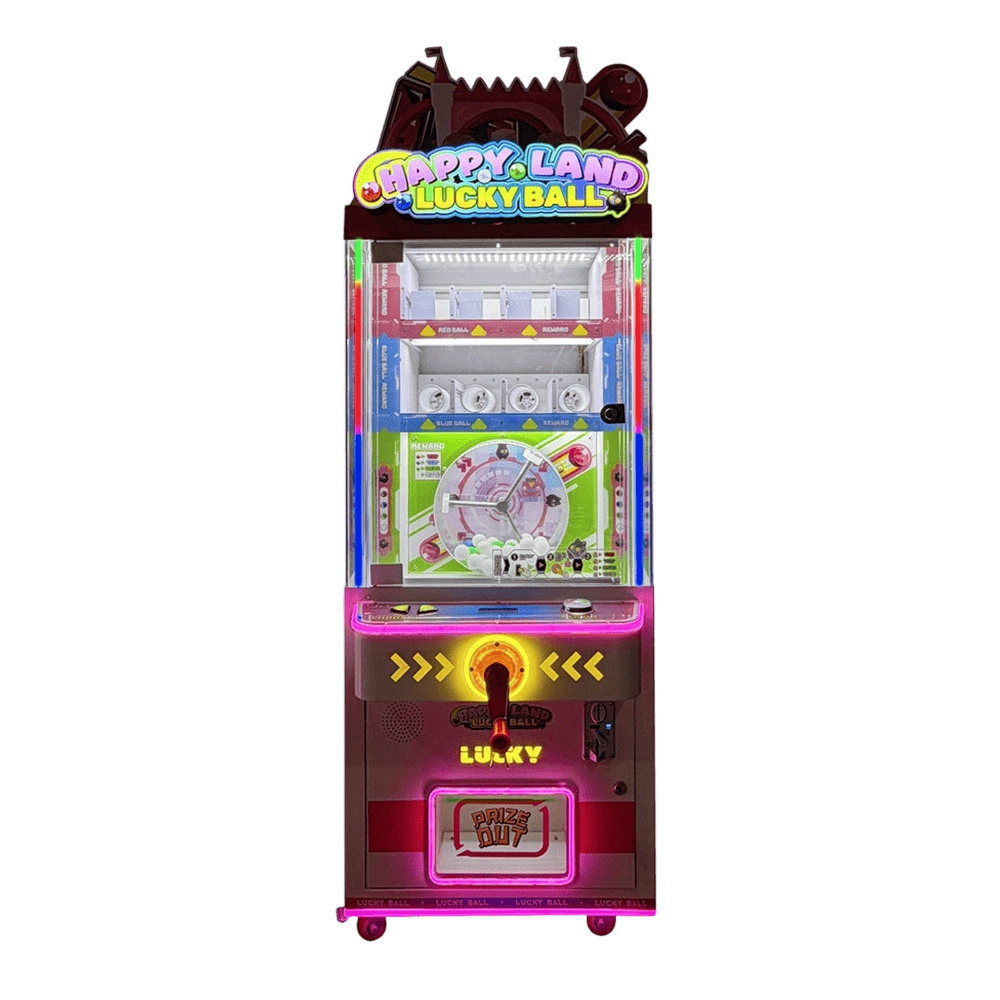
Coin Operated/Card Payment 2 Players SPIN ORBIT Lucky Prize Arcade Game
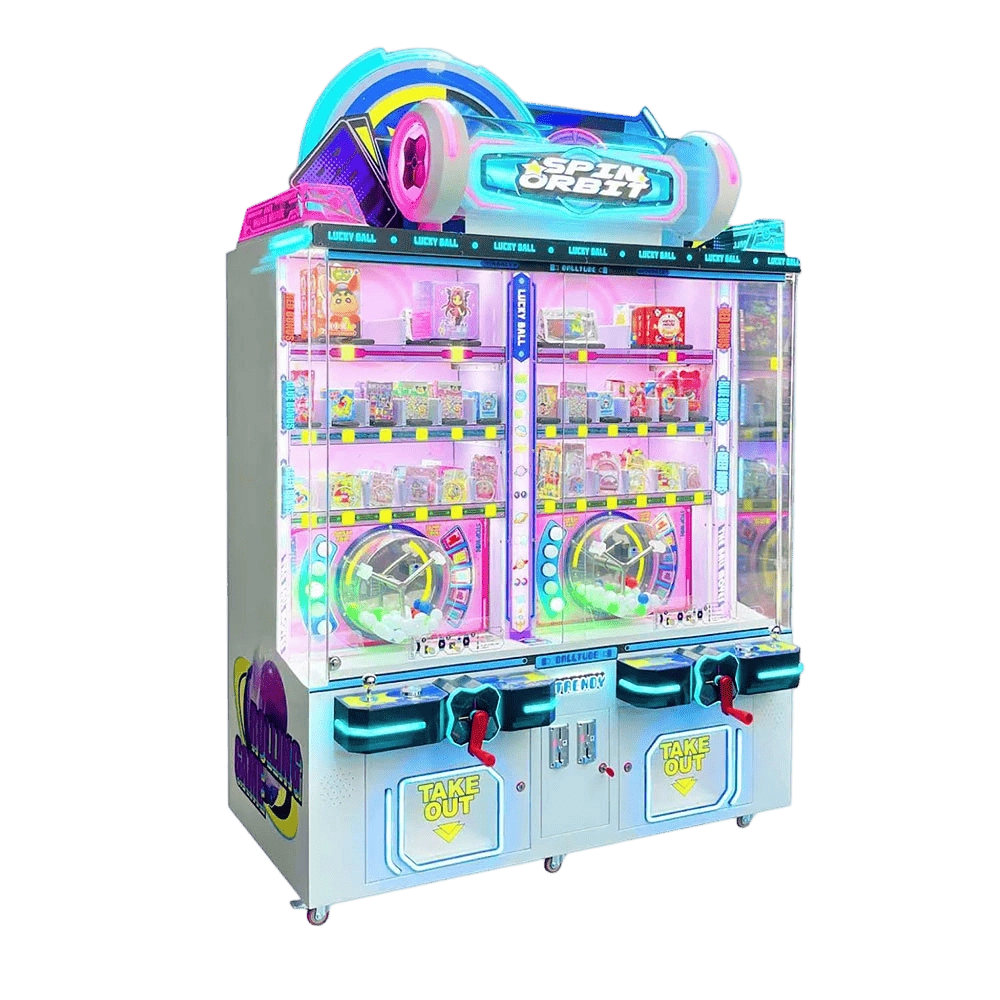
Coin Operated/Card Payment SPIN ORBIT Lucky Prize Arcade Game
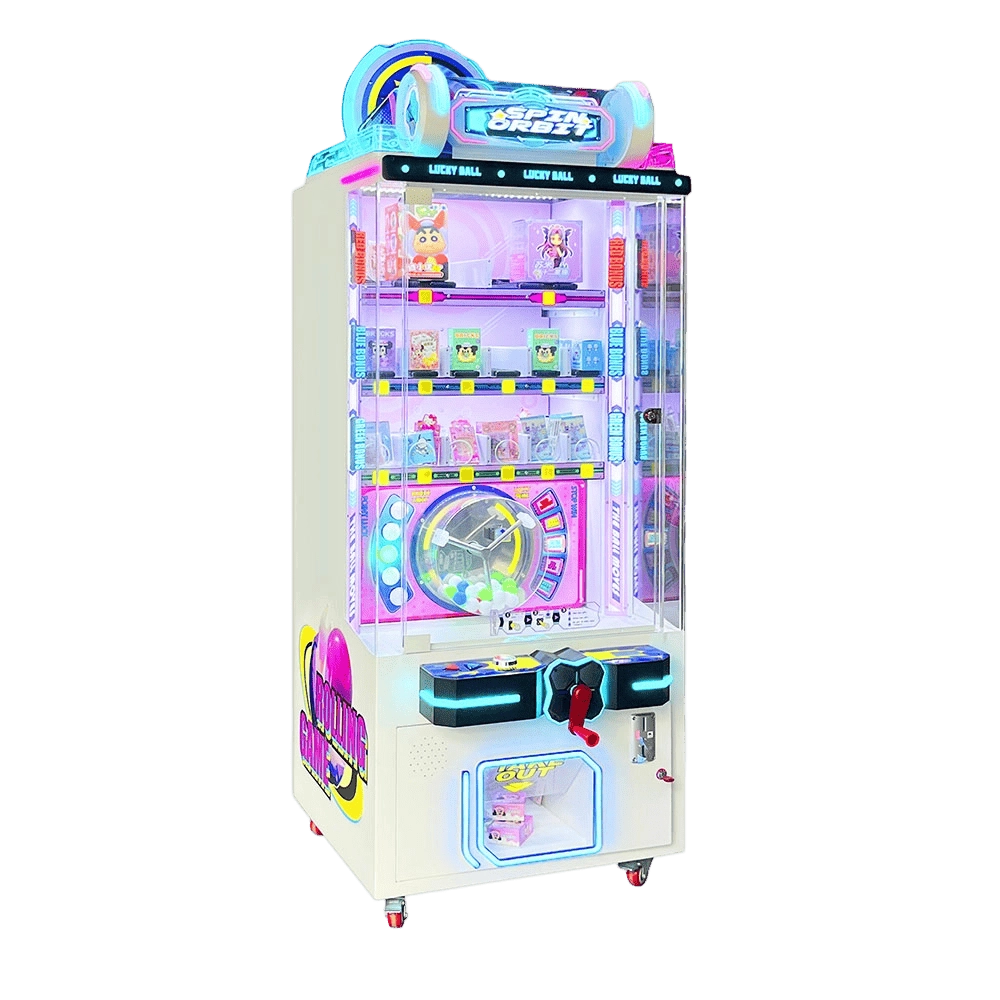
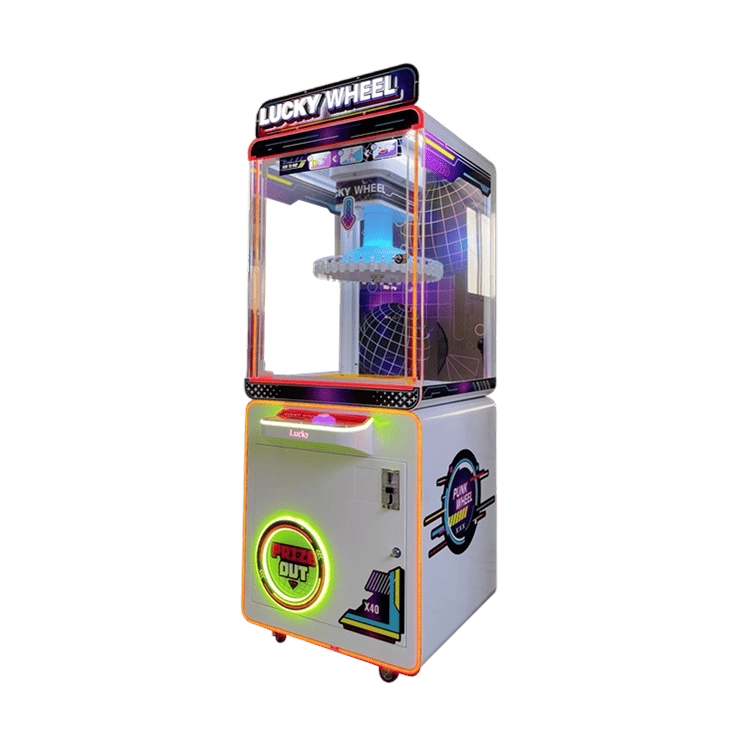
Arcade Prize Lucky Wheel Gift Machine For Amusement Areas
Get in Touch with Jiami Games
If you have any comments or good suggestions, please leave us a message; later our professional staff will contact you as soon as possible.

Innovative Entertainment, at Your Fingertips
Learn about Jiami Games and explore our expertise in console development, innovative design, and global markets.
Quick Links:
© 2026 Jiami Games.
Whatsapp: +8618520390438